Table of Contents: Court Marriage Legal Dossier
1. Statutory Foundation: The Special Marriage Act, 1954
In India, marriage is ordinarily tied to religious rites under community-specific personal laws—such as the Hindu Marriage Act, 1955, the Muslim Personal Law (Shariat) Application Act, 1937, or the Indian Christian Marriage Act, 1872. However, for citizens who choose to marry outside caste, community, or religious boundaries, or who prefer a secular civil contract free from priestly rituals, Parliament enacted the Special Marriage Act, 1954 (Act No. 43 of 1954).
A "Court Marriage" in statutory terms is the solemnization of marriage directly before a Marriage Officer (typically the Sub-Divisional Magistrate or Additional District Magistrate) under Chapter II of the Special Marriage Act. The most defining constitutional virtue of the Special Marriage Act is that neither party is required to convert, adopt a new religious identity, or renounce their ancestral faith. The marriage is entered into as a civil covenant under the Constitution of India, conferring complete judicial legitimacy and equal legal rights.
2. Section 4 Conditions Relating to Solemnization of Special Marriages
Under Section 4 of the Special Marriage Act, 1954, a civil marriage cannot be solemnized unless four mandatory statutory prerequisites are fully satisfied by both parties:
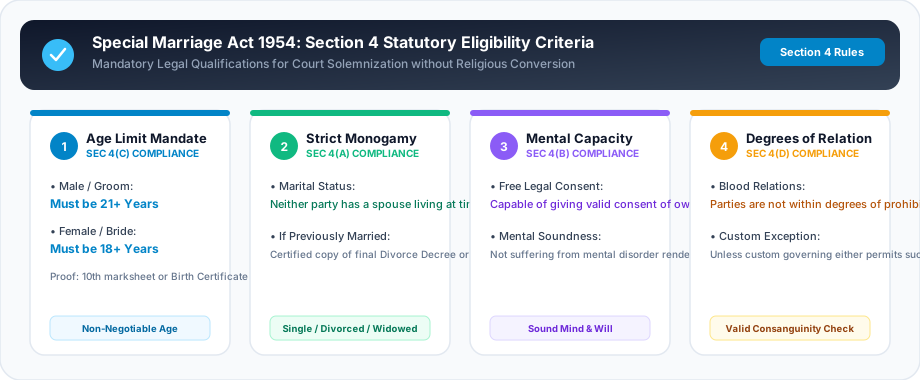
Figure 4.1: Section 4 Statutory Eligibility Framework under the Special Marriage Act 1954.
Neither party must have a spouse living at the time of marriage. If previously married, a certified Divorce Decree from a competent Family Court or Death Certificate of the former spouse is mandatory.
Neither party must be incapable of giving valid legal consent due to unsoundness of mind, mental disorder rendering them unfit for marriage, or recurrent attacks of insanity.
The male partner must have completed 21 years of age, and the female partner must have completed 18 years of age. Under-age marriages are legally void ab initio.
The parties must not be within the degrees of prohibited relationship (e.g. lineal ascendants/descendants, siblings, first cousins), unless custom governing at least one party permits such union.
3. The 30-Day Notice of Intended Marriage & Overcoming Objections
Under Section 5 of the Act, when a marriage is intended to be solemnized under Chapter II, the parties must deliver a formal written notice in the form specified in the Second Schedule to the Marriage Officer of the district in which at least one of the parties has resided for a period of not less than thirty (30) days immediately preceding the date of filing.
Establishing 30-Day Territorial Residence: Proving continuous local stay requires credible documentation. Acceptable documentary proofs include: a registered residential rent agreement executed at least 30 days prior, an employer letter certifying posting and local residential address, a bank passbook showing active local transactions, or a municipal gas / electricity connection in the applicant's name. A mere hotel stay or temporary lodge receipt is routinely rejected by Marriage Officers.
Under Section 6, the Marriage Officer keeps all notices in the official Marriage Notice Book and causes a true copy to be affixed to some conspicuous place in his office. If one of the parties resides in a different district, the Marriage Officer is statutorily mandated to forward a certified copy of the notice to the Marriage Officer of that other district to be affixed on their notice board as well. This initiates the mandatory 30-day public objection period.
Any person may, before the expiration of thirty days from the date of publication, object to the marriage on the sole ground that it would violate one or more conditions specified in Section 4 (e.g., that one party is already married, under-age, or mentally incapacitated).
Under Section 9 of the Special Marriage Act, the Marriage Officer is vested with all the powers of a Civil Court under the Code of Civil Procedure, 1908 (CPC) when holding an inquiry into objections. The Marriage Officer has the legal authority to summon witnesses, enforce attendance under oath, compel discovery and production of documents, and examine witnesses upon interrogatories.
Crucial Rule: Objections filed by family members or community groups asserting caste disparity, religious mismatch, or parental disapproval are legally INVALID and must be summarily dismissed by the Marriage Officer under Section 8(1). If an objection is found to be mala fide, the Marriage Officer can impose statutory costs on the objector.
4. The 5-Stage Court Marriage Lifecycle Flowchart
The lifecycle of a civil court marriage from initial notice delivery to final statutory certification is delineated in the diagram below:
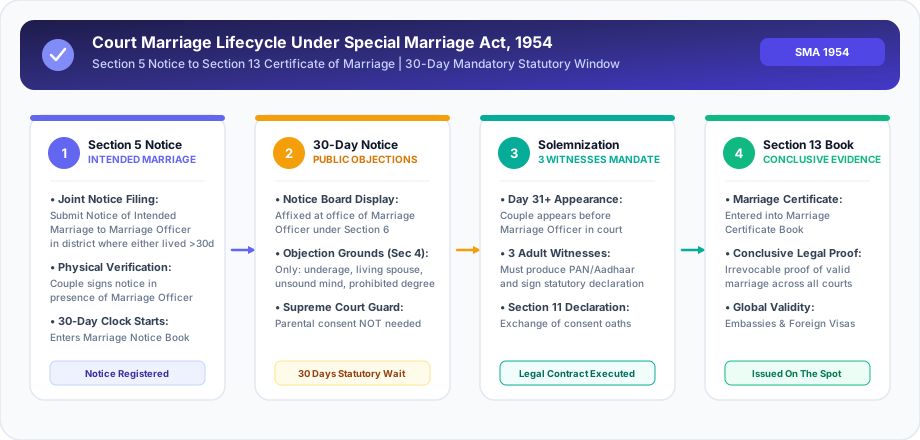
Figure 4.2: End-to-End Procedural Flowchart: Notice, 30-Day Display, Inquest, Solemnization & Certificate.
5. The Role of the Three Witnesses & Legal Liabilities
Under Section 11 of the Special Marriage Act, 1954, before the marriage is solemnized, the parties and three witnesses must, in the presence of the Marriage Officer, sign a formal declaration in the form specified in the Third Schedule.
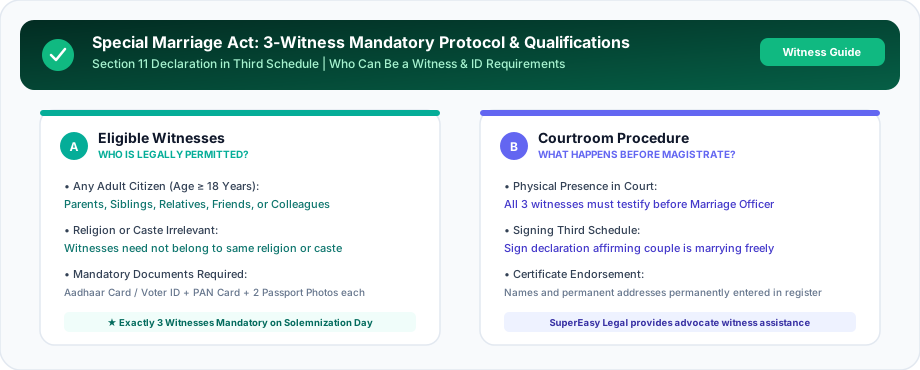
Figure 4.3: Witness Eligibility, Statutory Responsibilities, and Legal Liabilities under Special Marriage Act.
Key Witness Legal Rules:
- Three Witnesses are Mandatory: While Hindu Marriage Act registrations require only two witnesses, the Special Marriage Act strictly mandates three independent witnesses.
- No Family Requirement: Witnesses need NOT be parents or family members. Friends, colleagues, neighbors, or acquaintances above 18 years of age are fully competent under law.
- Witness Legal Liability: A witness certifies only the identity of the bride and groom and that the declarations were signed in their presence. They carry no financial or marital liability for the couple's personal life.
6. Step-by-Step Procedure for Court Marriage
Below is the comprehensive operational protocol for executing a civil court marriage under the Special Marriage Act:
Jurisdiction Determination & Notice Drafting
Identify the Marriage Officer (SDM) in whose jurisdiction either the bride or groom has resided for at least 30 continuous days prior to filing. Prepare the Notice of Intended Marriage (Schedule II), annexing Proof of Age (10th certificate/passport), Proof of Residence (Aadhaar/voter ID/rent agreement), passport photographs, and notarized affidavits.
Physical Appearance & Notice Submission
Both parties attend the SDM office to submit the Notice of Intended Marriage. The Marriage Officer verifies original documents, collects statutory fee (typically ₹100 to ₹150), and enters the notice into the Marriage Notice Book. A copy is formally affixed to the public notice board.
30-Day Objection Waiting Period
The law enforces a strict 30-day waiting period starting from the date of publication. If no objections are received within this period, the marriage can be solemnized at any time within three (3) calendar months from the date of notice publication.
Solemnization Day: Declarations Before 3 Witnesses
On the appointed solemnization date, the couple appears before the Marriage Officer accompanied by their three witnesses. The parties make the statutory declaration under Section 12: "I, [A], take thee [B], to be my lawful wife/husband." Bride, groom, and all 3 witnesses sign the declaration.
Issuance of Certificate of Marriage (Section 13)
The Marriage Officer enters the certificate in the official Marriage Certificate Book and issues a certified copy of the Certificate of Marriage. This document constitutes conclusive proof of a valid marriage under Section 13(2) across all Indian and international courts.
7. Inter-Faith Marriages, Privacy Rights & Police Protection
Couples entering into inter-caste or inter-religious court marriages often face unlawful intimidation, threats of honor violence, or false criminal complaints (such as kidnapping under IPC 363 / BNS 137). The constitutional jurisprudence of India firmly protects consenting adults:
The Supreme Court held that the choice of an adult to marry a person of their choice is a constitutionally protected fundamental right under Article 19 and Article 21. No family member, khap panchayat, or vigilante group has the legal power to interfere in or harass such couples.
Couples apprehending danger to their life or liberty can file a protection writ petition under Article 226 before the jurisdictional High Court. The High Court routinely issues binding directions to the Commissioner of Police and local Station House Officer (SHO) to provide immediate personal security and ensure zero harassment.
8. Same-Day Court Marriage: Myths vs. Statutory Reality
Touts and unauthorized brokers across court complexes frequently market "Same-Day Court Marriages within 2 Hours". Every citizen must understand the critical legal reality behind this marketing claim:
- A pure Court Marriage under the Special Marriage Act can NEVER be performed in a single day. The 30-day notice period under Section 5 is a mandatory parliamentary statute that no SDM, advocate, or judge can waive or expedite.
- What agents advertise as "Same-Day Court Marriage" is actually an Arya Samaj Marriage solemnized in a trust hall followed by applying for registration under the Hindu Marriage Act.
- This route is available ONLY when both parties are Hindus, Sikhs, Buddhists, or Jains. It is legally unavailable for inter-religious marriages (e.g. Hindu-Muslim or Hindu-Christian) unless one partner executes a formal religious conversion, which is governed by strict state anti-conversion statutes.
9. Frequently Asked Questions (FAQs): Court Marriage Procedure
Clear, verified legal answers to the most common questions regarding court marriages under the Special Marriage Act 1954.
What is the legal difference between Court Marriage and Traditional Marriage Registration?
Is the 30-day notice period mandatory for Court Marriage in India?
Can a 30-day notice be sent to the parents' residential address?
What are the age requirements for Court Marriage in India?
How many witnesses are required for a Court Marriage under the Special Marriage Act?
Can friends or colleagues act as witnesses instead of parents?
Can an inter-faith couple perform a Court Marriage without changing their religion?
What happens if someone files a false or frivolous objection during the 30-day notice?
Is a same-day court marriage possible in India?
What legal protection is available to couples facing threats from family?

Advocate Rahul Singh, B.A. LL.B (Hons.)
Senior Documentation Counsel at SuperEasy Legal Services
Advocate Rahul Singh has over 14 years of specialized legal practice in Central Gazette notifications, civil affidavits, Special Marriage Act court marriage procedures, and statutory identity harmonization. Adv. Singh and his team have successfully facilitated over 15,000 gazette publications and matrimonial court filings across India with zero rejection rate.